




Updated on 16 November 2026
Montmartre looks wonderful in photos: stepped lanes, small squares, the white domes of Sacré-Cœur above the rooftops. Plenty of travellers fall for it on a day visit and start wondering whether they should simply stay there. So, is Montmartre a good place to stay? For some trips it is a lovely base. For others it turns into a daily climb and a long ride to everything else.
This guide is only about that decision: what staying on the hill gives you, what it costs you in stairs and travel time, which part of Montmartre to pick, and where to look instead if it is not the right fit. For the sights themselves, see our Montmartre guide.
- What Is Good About Staying in Montmartre
- The Downsides: Hills, Stairs and Distance
- Getting Around From Montmartre
- The Back Way Up: How We Usually Do Montmartre
- Which Part of Montmartre to Choose
- Is Montmartre a Good Place to Stay? Who It Suits and Who It Doesn’t
- Before You Book a Hotel in Montmartre
- If Not Montmartre, Then Where?
- Frequently Asked Questions
- Summary
- Download the Paris For You App
SHORT ANSWER
► Yes, Montmartre is a good place to stay if you want a village feel and a lively neighbourhood in the evening, and you are fine with hills, stairs and a metro ride to most other sights.
► Less so for a short first trip, for anyone who finds stairs hard, or if you want to walk to the Louvre, Notre-Dame and the Seine.
► Best part to stay: the streets around Abbesses, Rue Lepic and Lamarck–Caulaincourt.
► Think twice about hotels on Boulevard de Clichy and around Barbès at the eastern foot of the hill.
► A flat alternative close by: South Pigalle (SoPi) in the 9th arrondissement.
What Is Good About Staying in Montmartre
The biggest advantage is the neighbourhood itself. Montmartre still feels like a village that the city grew around: steep cobbled streets, small squares, bakeries and wine bars that are there because people live here. Staying on the hill means you see it after the day visitors have gone, early in the morning when the steps below Sacré-Cœur are almost empty, and in the evening when the lights of Paris come on below you.
It is also a good place to come back to at the end of the day. The streets around Place des Abbesses and Rue Lepic have cafés, restaurants and food shops, so you do not have to cross the city for dinner. Rue Lepic is a market street with bakeries and cheese shops, handy for breakfast or a picnic.
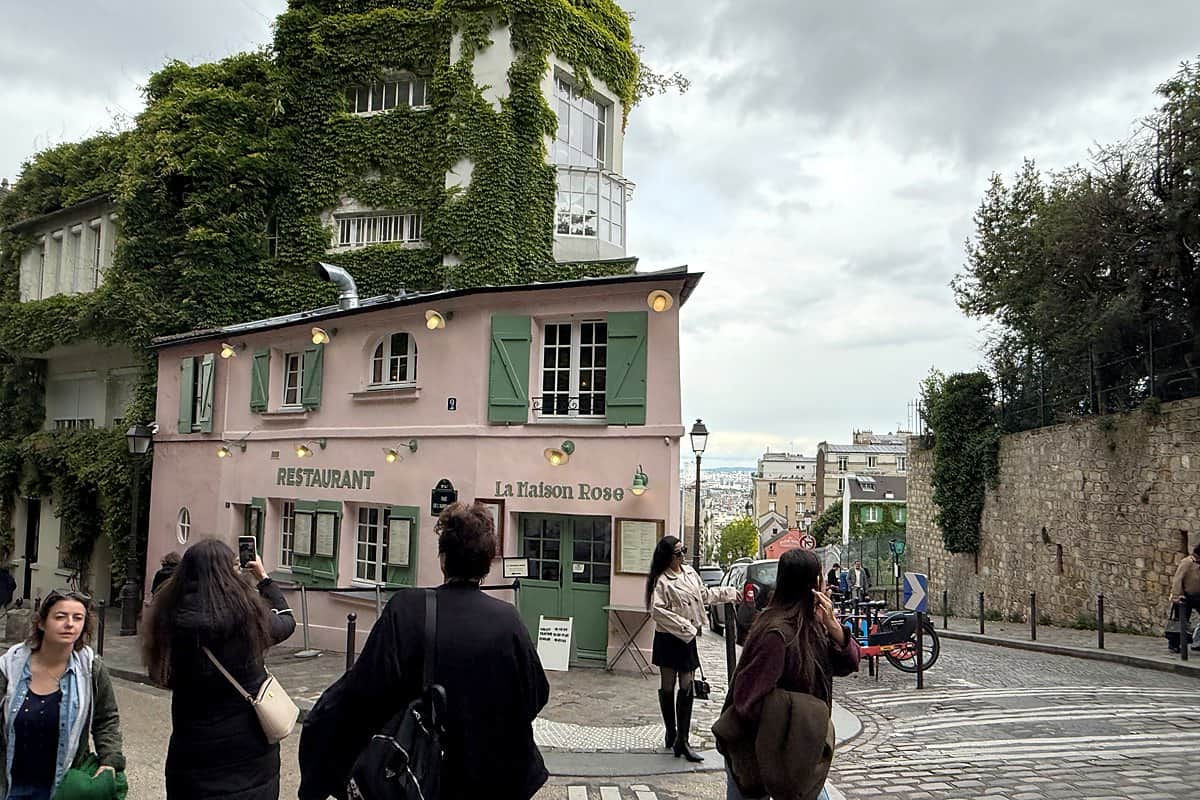
For photographers, Montmartre is worth the extra distance. Rue de l’Abreuvoir, the pink café La Maison Rose and the Clos Montmartre vineyard are a few minutes’ walk from each other, and they look very different before the crowds arrive. If you would like someone to show you around on your first morning, a guided walk is an easy introduction to the hill.
It is also well connected to part of the city. Metro line 12 runs from Lamarck–Caulaincourt and Abbesses straight to Saint-Lazare, Madeleine, Concorde and Solférino, the stop for the Musée d’Orsay, without a change.
The Downsides: Hills, Stairs and Distance
The hills and stairs are part of daily life
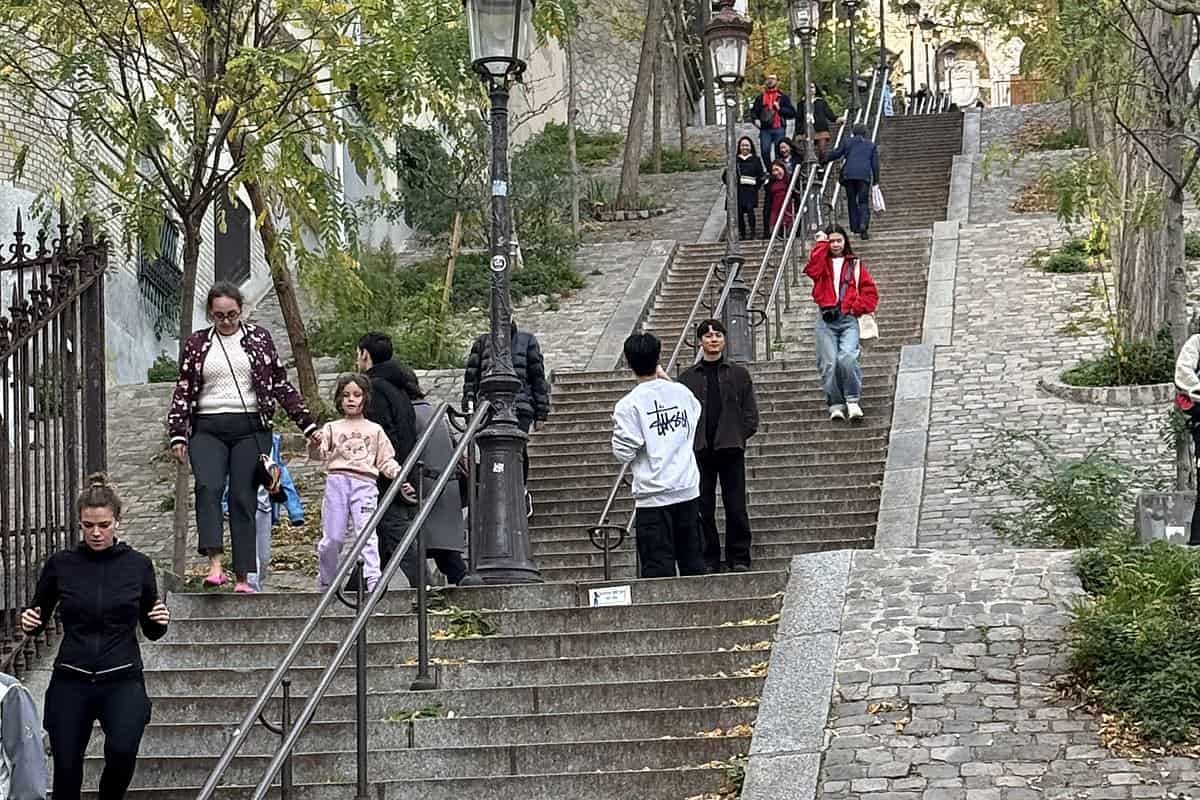
Montmartre is a hill, about 130 metres (430 ft) above sea level at the top and the highest natural point in Paris. Many streets are steep, and some are not streets at all but staircases. The best known is Rue Foyatier, the 222 steps beside the funicular up to Sacré-Cœur. If your hotel is on the upper part of the hill, every return in the evening is a climb. On a long weekend that is part of the charm. After a week of museums and long walks, it can wear you down.
Some metro stations are very deep
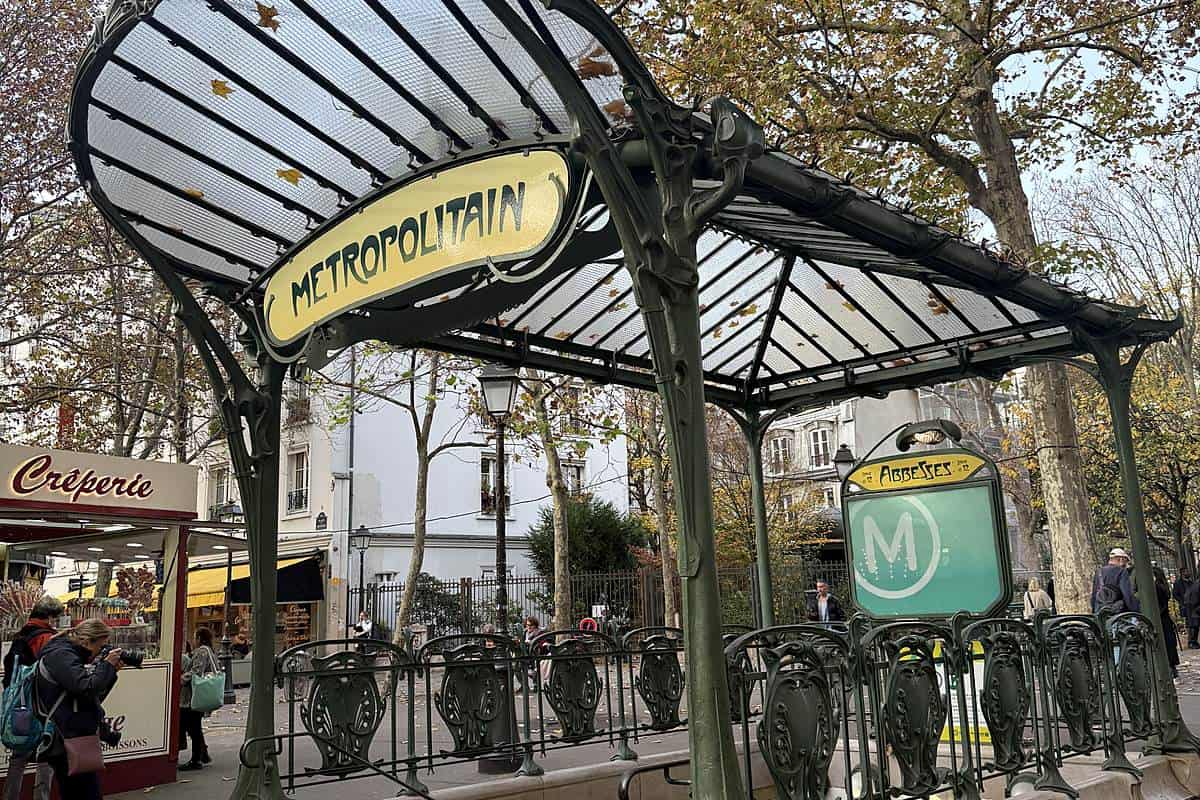
The two stations closest to the village, Abbesses and Lamarck–Caulaincourt on line 12, are among the deepest in Paris. According to RATP, the platforms at Abbesses are more than 30 metres (100 ft) below the street. Both stations have lifts, but when a lift is out of service the alternative is a long spiral staircase. We have climbed both on foot, and it is a workout. The RATP website shows the live status of station lifts, which is worth checking if stairs are a problem for you.
Most of the big sights are a ride away
Montmartre is in the 18th arrondissement, roughly 4 km (2.5 miles) north of the centre. That is outside the central arrondissements, the 1st to the 9th, that we usually suggest for a first visit, where the Louvre, Notre-Dame, the Marais and the Seine are within walking distance. From Montmartre you will take the metro most days, and for the Eiffel Tower, the Louvre, the Marais or Notre-Dame you usually need a change. Add the walk down to the station and the climb back up, and a trip across town takes longer than the map suggests.
Crowds at the top, a rough edge at the bottom
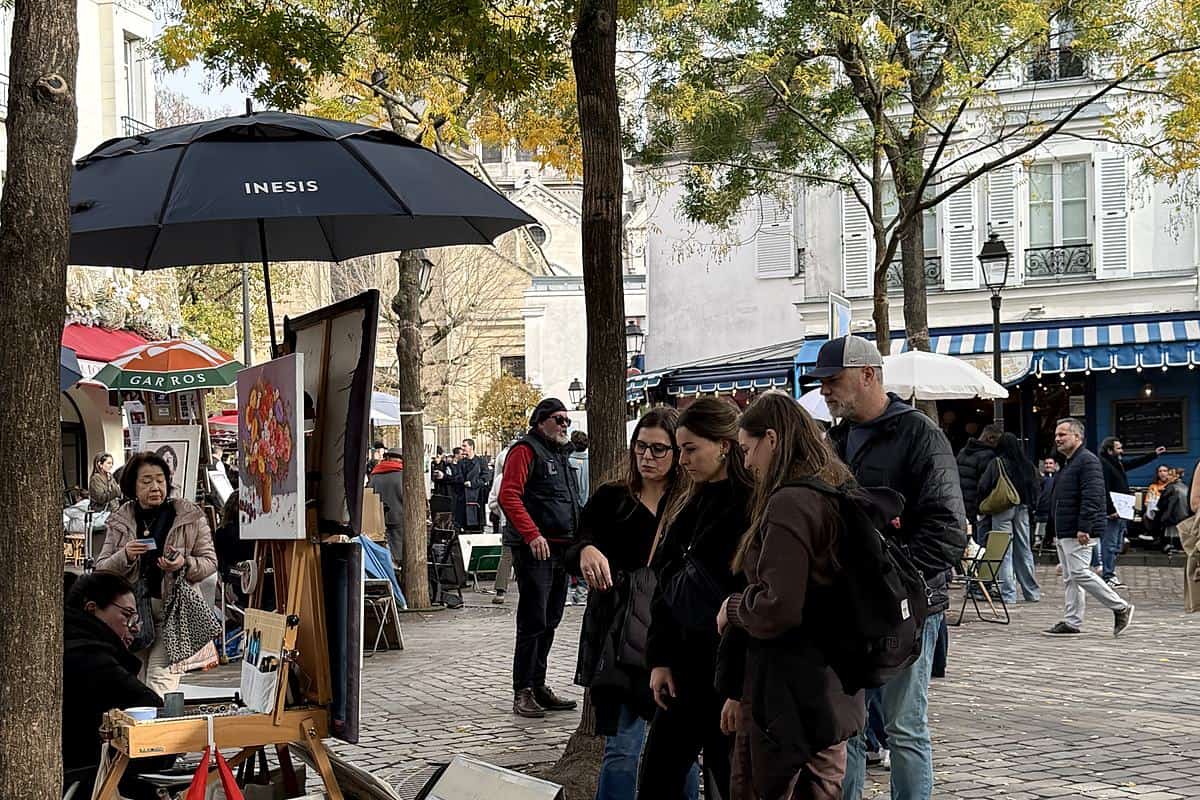
The area around Sacré-Cœur and Place du Tertre is one of the busiest in Paris during the day: crowds, portrait artists, souvenir shops and, on the steps up from Anvers, persistent bracelet sellers and petition holders. Pickpockets work these crowds too.
The bottom of the hill is mixed. Boulevard de Clichy around Pigalle and the Moulin Rouge is a nightlife and red-light strip, busy and noisy and not restful as a base. To the east, the streets around Barbès-Rochechouart and Château Rouge have a reputation for being uncomfortable, especially after dark. Our guide to whether Paris is safe for tourists covers these areas in more detail.
Getting Around From Montmartre
Knowing which station serves which part of the hill makes a big difference to your days.
- Line 12 (Lamarck–Caulaincourt, Abbesses, Pigalle): the most useful line for visitors. It runs south without a change to Saint-Lazare, Madeleine, Concorde, Solférino (Musée d’Orsay), Rue du Bac and Montparnasse.
- Line 2 (Blanche, Pigalle, Anvers): runs along the foot of the hill and west to Charles de Gaulle–Étoile for the Arc de Triomphe. Anvers is the station for the funicular.
- The funicular: takes you from the bottom of the gardens below Sacré-Cœur to the top in under two minutes, for the price of a Metro–Train–RER ticket or with a contactless bank card, one fare per ride. In our experience the queue is often long, especially at the bottom, and the stairs beside it can be quicker.
- Bus 40: a small bus that crosses the hill on its way between Le Peletier in the 9th arrondissement and Jules Joffrin, with stops near Abbesses, Rue Lepic, Place du Tertre and Lamarck–Caulaincourt (check the current stop list on the RATP website). It takes a Bus–Tram ticket or a contactless bank card, and it gets you up the hill without stairs.
Our guide to metro and bus tickets explains which ticket you need for each.
The Back Way Up: How We Usually Do Montmartre
The blue line and the letters A–I show the route; the purple pins are other spots worth a look along the way.
Many visitors arrive from the front: line 2 to Anvers, then the funicular or the 222 steps. We usually come from the back instead, and if you stay on the hill it is a route you may walk often.
- Take line 12 to Lamarck–Caulaincourt. It is a deep station with a single entrance and a staircase, but it also has lifts.
- Walk up to Place Dalida, the small square with a bronze bust of the singer, where Rue Girardon meets Rue de l’Abreuvoir.
- Follow the cobbled Rue de l’Abreuvoir to La Maison Rose on the corner of Rue des Saules.
- Look down Rue des Saules at the Clos Montmartre vineyard.
- Climb Rue des Saules to Rue Norvins and the corner café Le Consulat.
- Carry on to Place du Tertre and Sacré-Cœur.
- Walk down the front through the gardens below Sacré-Cœur, then head west to Place des Abbesses.
- Stop at Le Mur des je t’aime, the Wall of Love, in the small garden on the square.
- Follow Rue Lepic down the hill to Place Blanche and the Moulin Rouge, where line 2 takes you on.
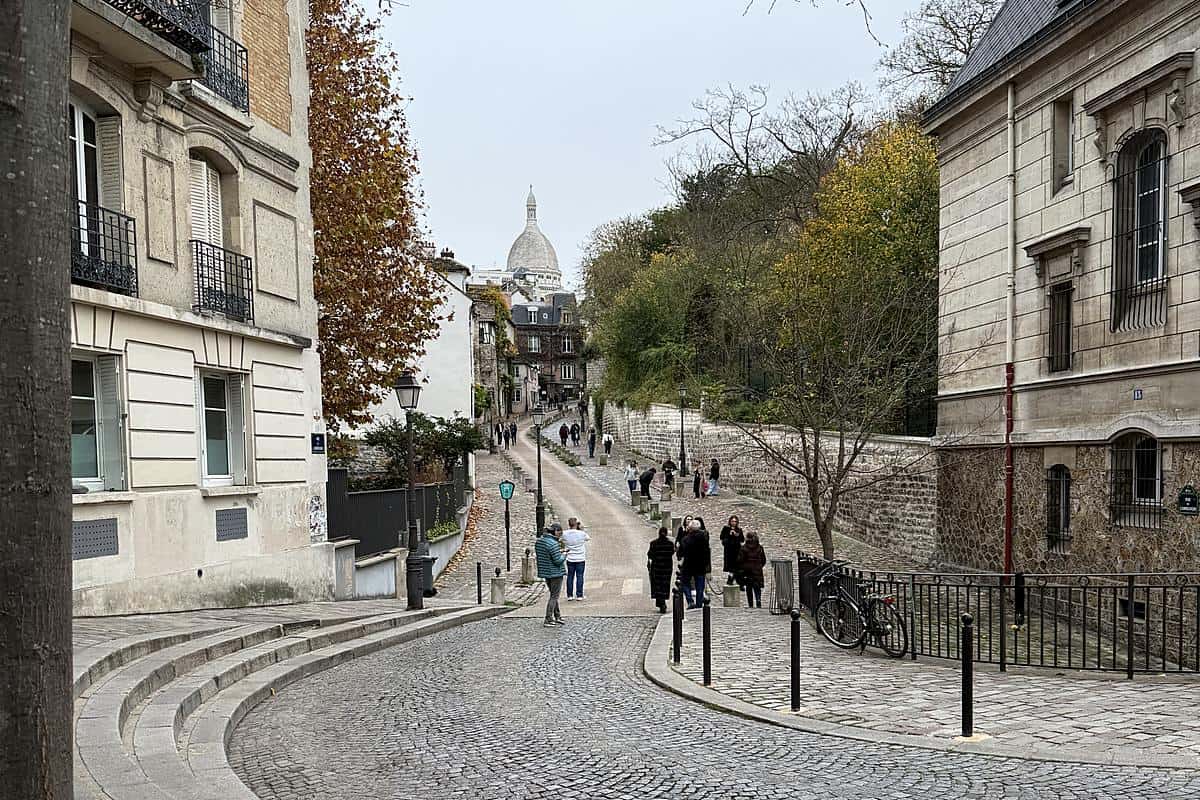
There are still a few steps and the streets climb, but it is a gentler way up than the front. The first part, from the station to the vineyard, is quiet. From Le Consulat onwards you are back among the crowds. The second half is all downhill, and Rue Lepic has bakeries and cafés on the way to the bottom.
If you want to go inside some of the sights on the hill, you can book tickets ahead:
Which Part of Montmartre to Choose
On a booking site, “Montmartre” can mean anything from a quiet lane below the vineyard to a hotel on the busy boulevard at the bottom of the hill. Always check the pin on the map, not just the name of the hotel.
| Area | What it is like | Good for | Watch out for |
|---|---|---|---|
| Abbesses and Rue Lepic | The village side of the hill: cafés, food shops, Place des Abbesses, lively in the evening | Most visitors who want Montmartre | Hills in every direction; Abbesses station is very deep |
| Lamarck–Caulaincourt and Rue Caulaincourt | Residential and calmer, close to the quiet back of the hill | Longer stays, light sleepers | Steep streets and stairs; fewer cafés on your doorstep |
| Around Place du Tertre and Sacré-Cœur | The postcard top of the hill | Being right by the views | Daytime crowds, tourist-facing restaurants, a climb from every station |
| Pigalle and Boulevard de Clichy | Flat, at the foot of the hill, lines 2 and 12 | Nightlife, easy metro | Red-light strip, noise and touts at night |
| Barbès, Château Rouge and further north-east (La Chapelle, Marx Dormoy, Porte de la Chapelle) | Busy commercial streets at the eastern foot of the hill | Passing through | Uncomfortable after dark; not a good base |
For most people the best choice is the area around Abbesses and Rue Lepic, or the quieter streets towards Lamarck–Caulaincourt. Our guide to where not to stay in Paris explains the Pigalle question in more detail.
→ Browse hotels in Montmartre on Booking.com
Is Montmartre a Good Place to Stay? Who It Suits and Who It Doesn’t
It suits you if
- you have been to Paris before, or you have four days or more and do not mind a daily metro ride
- you want a neighbourhood with its own life in the evening
- you like walking, uphill included
- you want Montmartre’s lanes and views early and late, without the crowds
- you care more about atmosphere than about being close to everything
You are better off elsewhere if
- it is your first trip and you have only two or three days
- stairs are hard for you or someone in your group, or you are travelling with a pushchair (stroller)
- you want to walk to the Louvre, Notre-Dame and the Seine
- you are hoping for quiet nights near Pigalle
→ Not sure which area suits you best? Try the Paris Area Finder
Before You Book a Hotel in Montmartre
Many hotels on the hill are in old buildings. In our experience, these are the things worth checking before you book:
- The exact address. Is the hotel on the hill, at the bottom, or on Boulevard de Clichy? Some Montmartre streets are staircases, so a taxi cannot always drop you at the door.
- A lift. Older Paris hotels often have very small lifts, and some have none. Also ask whether there are steps between the street and the lift.
- Room size. Paris hotel rooms tend to be small. Listings usually give the size in square metres; 15 m² is about 160 sq ft.
- Air conditioning. It is often missing in older hotels, and Paris summers have been hot in recent years.
- The walk to the metro. “Five minutes from the station” can mean five minutes uphill.
If you arrive with suitcases, a taxi to the door, where the street allows it, saves a lot of effort compared with deep stations and steps.
→ Browse hotels in Montmartre on Booking.com
If Not Montmartre, Then Where?
If Montmartre’s atmosphere appeals but the hills and the distance do not, these are good alternatives.
South Pigalle (SoPi), 9th arrondissement. Flat streets around Rue des Martyrs, just south of Boulevard de Clichy, with good restaurants, lines 2 and 12 close by, and Montmartre a walk uphill away. You get much of the evening atmosphere without the climb home.
The south side of Boulevard de Clichy also belongs to the 9th, so check the pin: you want the streets around Rue des Martyrs, not the boulevard itself.
→ Browse hotels in the 9th arrondissement on Booking.com
The Marais. Central and walkable, with Notre-Dame and the Seine on foot and a strong evening life. On a first trip it puts you close to most of what you came to see, and Montmartre is an easy half-day trip from there.
→ Browse hotels in the Marais on Booking.com
Saint-Germain-des-Prés. Calmer and more classic, on the Left Bank, with the Musée d’Orsay and the Luxembourg Garden close by. Line 12 from Rue du Bac or Sèvres–Babylone takes you straight to Abbesses when you want an evening on the hill.
→ Browse hotels in Saint-Germain-des-Prés on Booking.com
Our guide to the best areas to stay in Paris for first-time visitors compares these and other central neighbourhoods.
Frequently Asked Questions
The village streets around Abbesses, Rue Lepic and Lamarck–Caulaincourt are generally pleasant by day and in the evening, with the usual city precautions. Take more care on Boulevard de Clichy at night, around Barbès and Château Rouge, and with your belongings in the crowds near Sacré-Cœur.
It is about 4 km (2.5 miles) north of the centre. Line 12 goes directly to Concorde and the Musée d’Orsay, but the Eiffel Tower, the Louvre and Notre-Dame usually need a change. On a short first trip, that travel time adds up.
Abbesses and Lamarck–Caulaincourt on line 12 serve the village. Both are deep but have lifts. Pigalle, on lines 2 and 12, is better connected but sits on the busy boulevard.
No. Pigalle is at the foot of the hill. The streets above it are Montmartre, Boulevard de Clichy itself is a nightlife strip, and South Pigalle (SoPi), south of the boulevard in the 9th arrondissement, is a pleasant, flat area.
It can be if you have four days or more and like walking. For two or three days, a central area such as the Marais saves you a lot of travel time, and Montmartre works well as a half-day visit.
Not at the metro gates yet. A contactless bank card works on buses, including bus 40, and on the Montmartre funicular, and the metro is being added in stages over the coming years. For the metro, use a Metro–Train–RER ticket on a Navigo Easy card or in the official app.
Older children who like walking often enjoy it. With a pushchair or small children, the hills, stairs and deep stations make every day harder, and a flatter, more central area is easier.
Take a taxi to the door if the street allows it. If you arrive by train at Gare du Nord or Saint-Lazare, the taxi ride up the hill is short. If you come by metro, Abbesses and Lamarck–Caulaincourt have lifts. Check before you book how many steps there are between the street and the hotel reception.
Summary
Montmartre is a good place to stay if you value atmosphere over convenience: a village feel, lively evenings and the hill to yourself early and late. In return you accept hills, stairs, deep metro stations and a ride to most of the big sights. If you choose it, look at Abbesses, Rue Lepic and Lamarck–Caulaincourt, think twice about Boulevard de Clichy and the streets around Barbès, and check the lift and the exact address. If it is a short first trip or stairs are a problem, stay somewhere central or in South Pigalle and come to Montmartre for a day, from the back.
Download the Paris For You App
Montmartre’s winding streets are easy to get lost in, which is half the fun until you need to find your hotel. The Paris For You app keeps the map offline, so it works without mobile data. The Paris Top Insta Spots map marks the photo spots on the hill and across the rest of the city.
Make your Paris trip simpler.
Download Paris For You and explore the city like a local.
Download on Android
Download on iPhone