




Updated on 23 October 2026
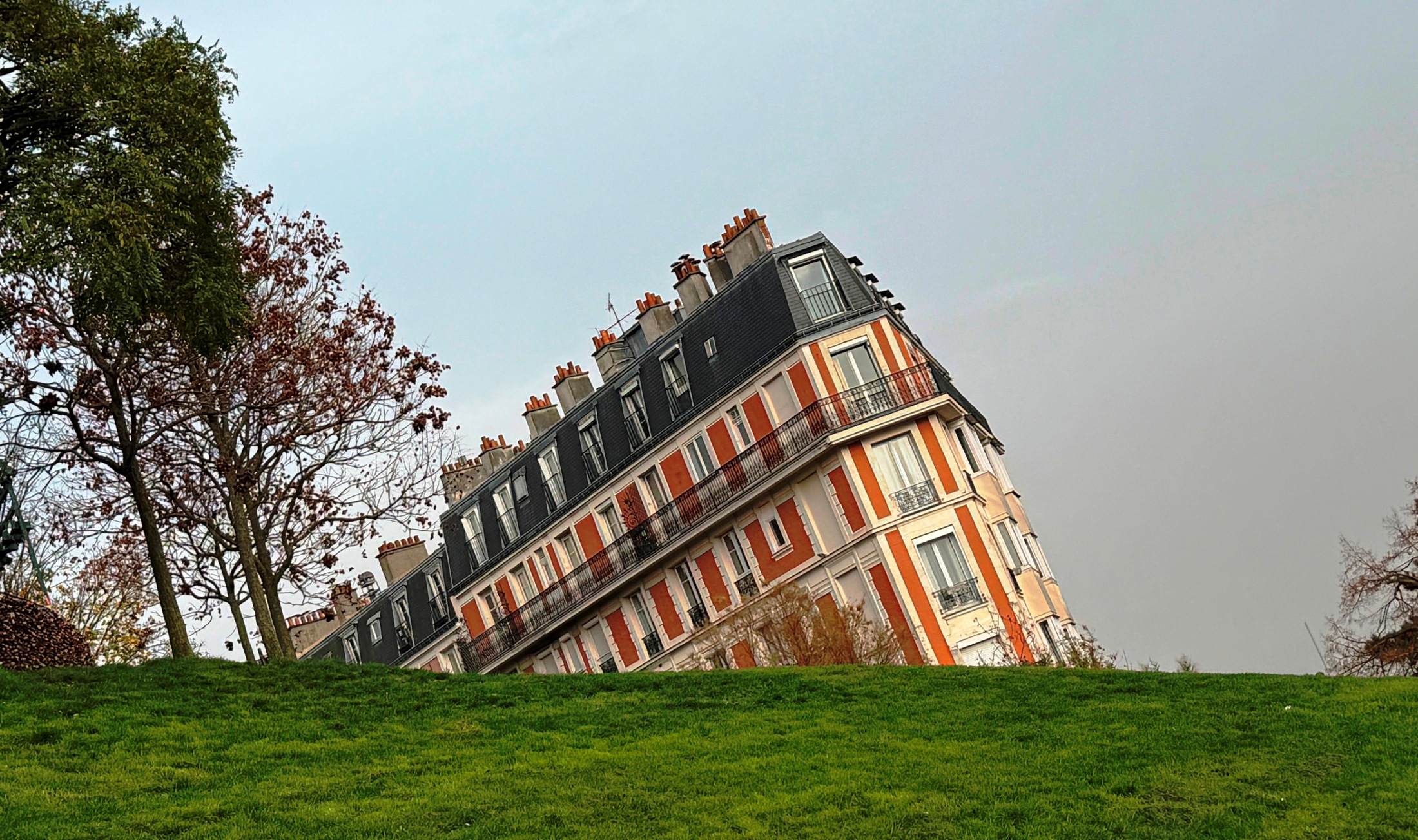
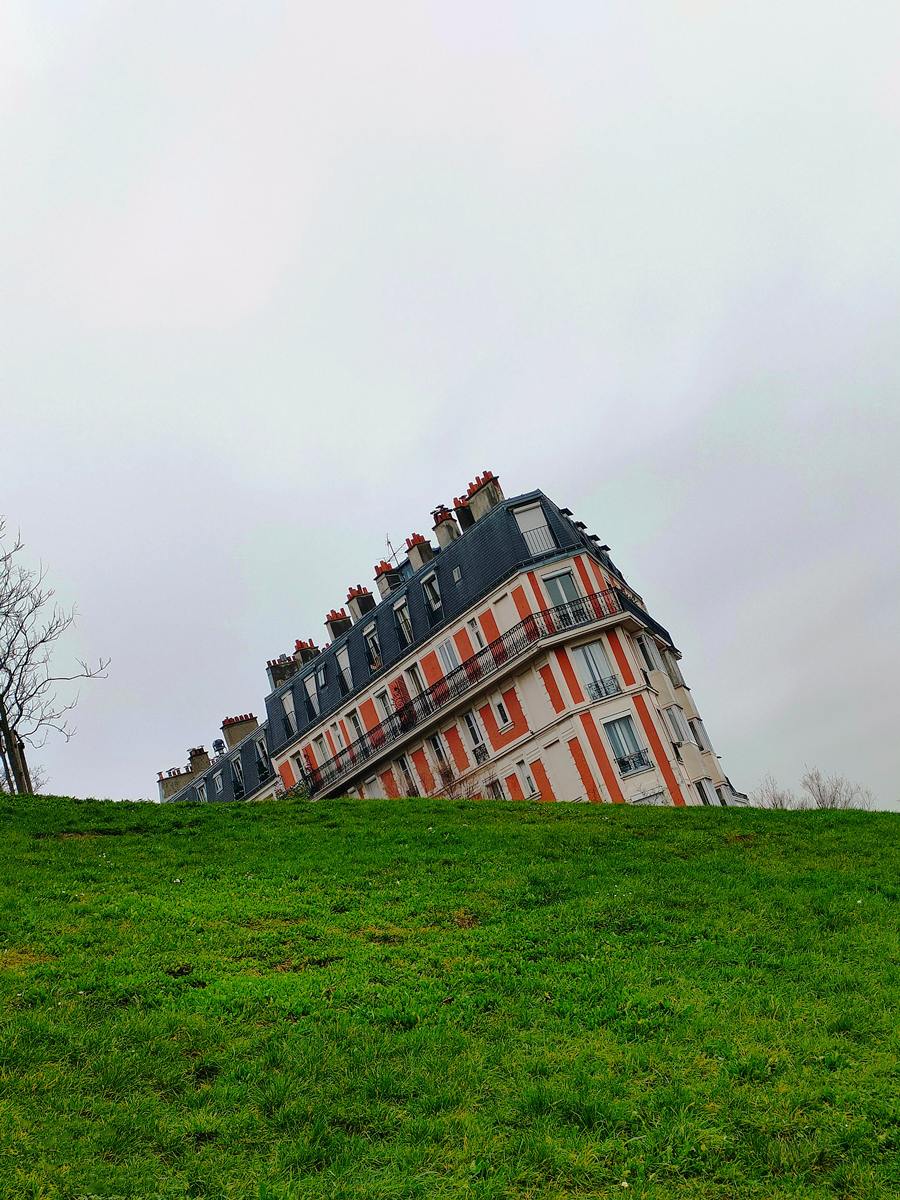
If you’ve ever seen a Paris photo where a handsome Haussmannian building looks like it’s sliding into a green hillside, you’ve met the Sinking House of Montmartre. Spoiler: the house itself is not moving. The “sinking” effect is a playful perspective trick created by the steep lawn directly below the Sacré-Cœur Basilica. Align the sloping grass as your horizon, and the building beside it will appear to tilt or “sink.” Simple, satisfying, and very Paris.
This guide keeps it practical: what the illusion is, exactly where to stand, how to nail the shot in minutes, and how to fold it into a short Montmartre walk. You’ll also find it pinned in our Paris Top Insta Spots themed map inside the Paris For You app—perfect for hopping between camera-friendly locations without second-guessing directions.
- What it actually is (and isn’t)
- Exactly where to find the view
- How to capture the “sinking” photo
- When to go for best results
- Micro-walk: A neat Montmartre loop (30–60 minutes)
- Smart etiquette (so we all keep the shot)
- Quick facts to impress your travel companions
- Troubleshooting common hiccups
- Why add it to your Paris plan?
- Make it easy with the Paris For You app
- FAQ
- Useful links
- Download the Paris For You app
The short version
▶ Where: on the green slope with lawns and staircases right below Sacré-Cœur (Square Louise-Michel on maps).
▶ How: tilt your camera to level the sloping lawn, not the skyline.
▶ Cost: free.
▶ Metro: Anvers (line 2), then walk up Rue de Steinkerque.
▶ Note: the park closes in the evening, earlier in winter.
What it actually is (and isn’t)

- Not an architectural oddity. The building is perfectly normal. The hill is not. When you level your camera to the lawn—rather than the true horizon—the façade reads as angled. Your brain fills in the rest.
- A product of topography. Montmartre is the highest natural point in Paris. Those photogenic stairs and terraces climb a serious slope, and that slope is the magic ingredient.
Because the effect relies on camera alignment, you don’t need a specific doorway or apartment number. Any viewpoint where the building sits beside a continuous strip of lawn will do—and one spot in particular makes it effortless.
Exactly where to find the view
The view is from the green, terraced slope right in front of Sacré-Cœur: the lawns and grand staircases that climb from the carousel at the bottom of the hill up to the basilica. If you have ever seen photos of people sitting on the grass below Sacré-Cœur, this is the place. On maps it is called Square Louise-Michel (until 2004 it was Square Willette, a name you may still see in older guides).
Walk up the main stairs toward the basilica. As you near the top terraces, look to the right-hand side: you’ll see the orange-cream apartment block that stars in most “sinking” photos. From the steps here, you have a clean line of grass in front and the building to the side—ideal for the illusion.
How to get there, simply:
- Metro: Ride Line 2 to Anvers and walk north along Rue de Steinkerque to the base of the hill.
- Alternate: Line 12 to Abbesses for a pretty wander through side streets.
- Skip the climb: The Montmartre funicular runs from the bottom of Square Louise-Michel up to the basilica terrace, and a standard Metro–Train–RER ticket covers the ride.
That’s all you need for location. No hunting specific doorbells. No detours. You’re already in position for the photo within a minute or two of reaching the upper steps.
How to capture the “sinking” photo
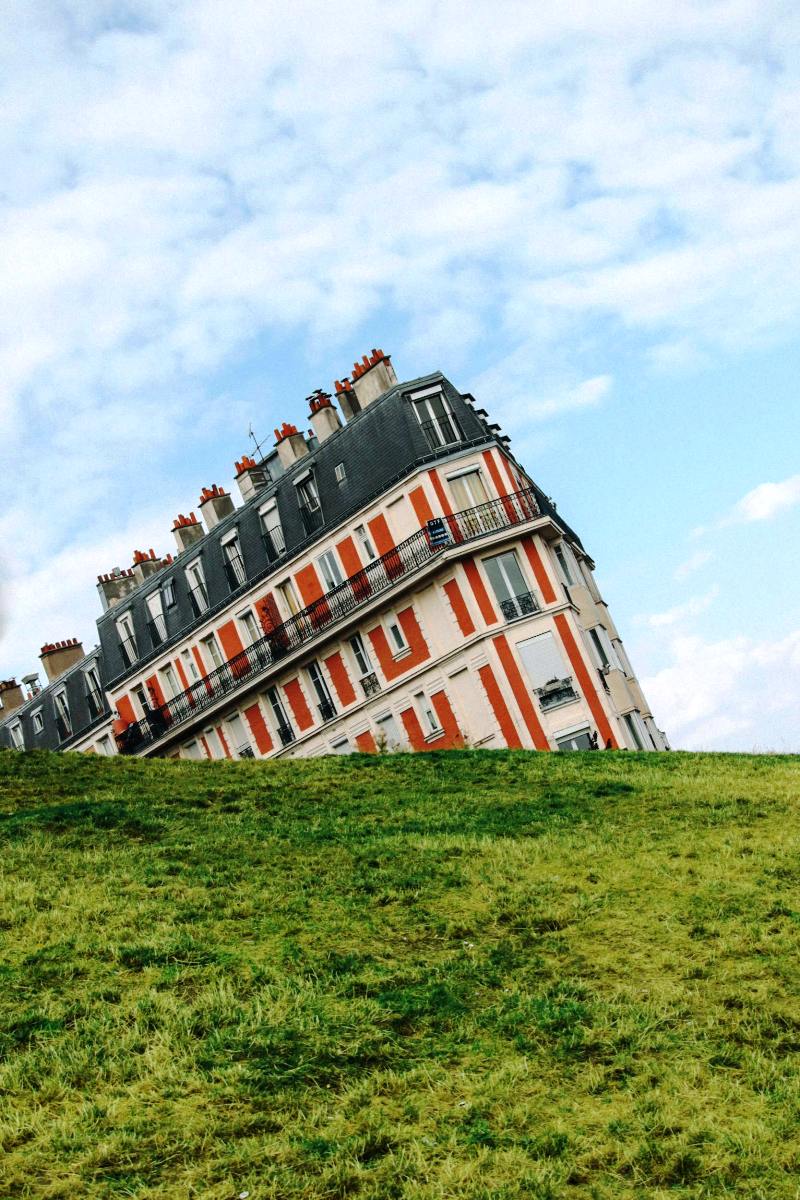
1) Level the lawn, not the skyline.
Turn on your camera’s grid if you have one. Rotate the phone so the strip of grass runs perfectly horizontal across your frame. The building will immediately “lean.”
2) Keep the tilt modest.
A small rotation—often 10–15 degrees—is more believable than a dramatic slant. The aim is charming illusion, not a disaster movie.
3) Choose the right focal length.
A standard or 2× lens on a phone keeps vertical lines cleaner than an ultra-wide. Step back a little if you need room; cropping later is easier than fixing distortion.
4) Add scale.
A person on the steps—standing “upright” while the house looks skewed—helps the viewer read the trick instantly. It’s also a nice opportunity for a playful portrait.
5) Watch edges and clutter.
Keep lamp posts, bins, and railings out of your borders if you can. Clean edges make the illusion feel intentional.
6) Shoot a safety version.
Take one photo with the lawn “straight” (illusion on) and one with your camera leveled to the real horizon (no illusion). The pair makes a fun before/after.
When to go for best results
- Early morning: Soft light, fewer people on the stairs, and even exposure across grass and façade.
- Late afternoon (golden hour): Warm side-light adds texture without harsh glare.
- Overcast days: Excellent for this shot. Flat light prevents the white basilica and pale stone from blowing out, and the green lawn pops gently.
Crowds ebb and flow all day at Sacré-Cœur. If you arrive to a busy scene, wait a minute between groups—Montmartre has a rhythm, and gaps do appear.
The green slope below Sacré-Cœur is a public park (Square Louise-Michel) with opening hours. It opens in the morning and closes in the evening, much earlier in winter than in summer, so check the times on the City of Paris website before planning a late-afternoon shot. Parts of the park are sometimes closed for works.
Micro-walk: A neat Montmartre loop (30–60 minutes)
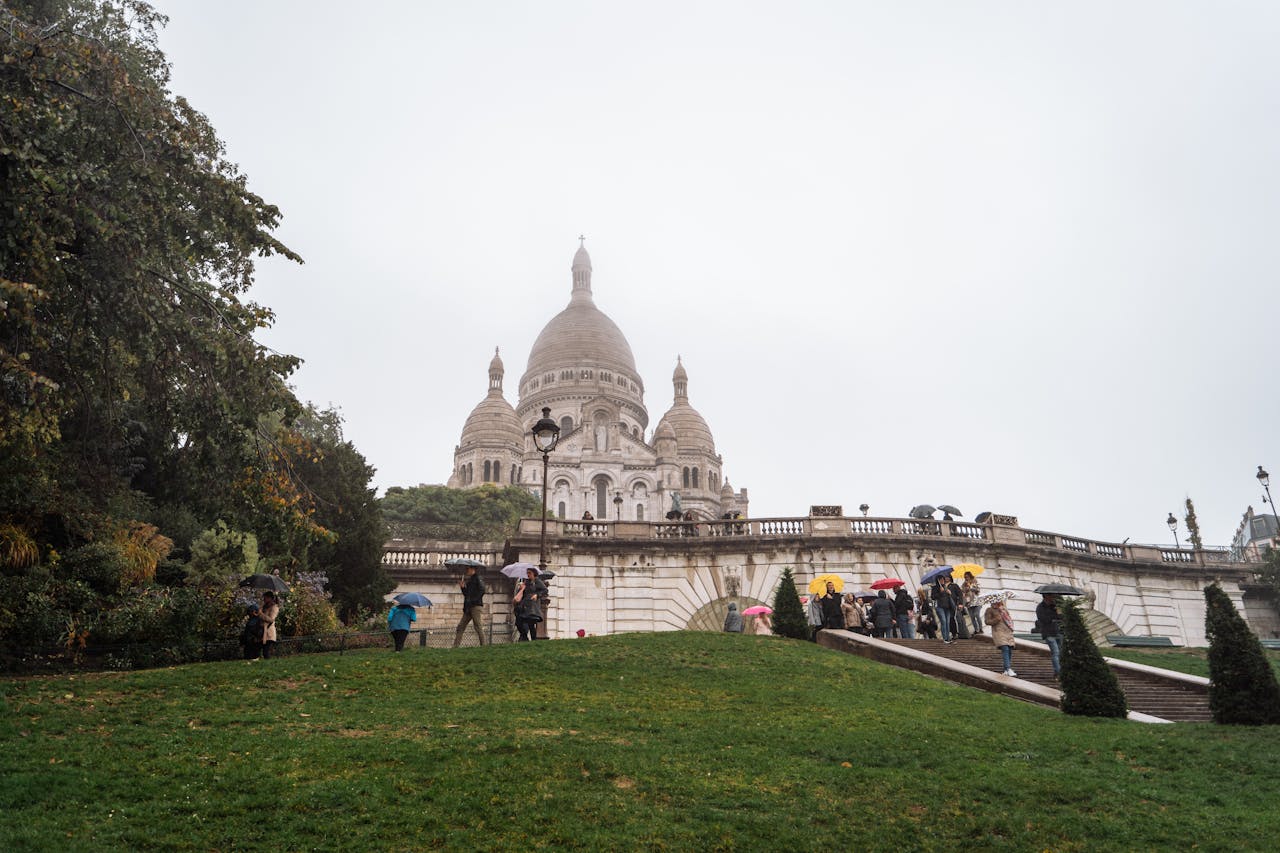
Make the most of the hill while you’re here.
- Sinking House viewpoint (5–10 min): Take the photo from the upper steps in Square Louise-Michel.
- Sacré-Cœur terrace (10–15 min): Climb one more level for the big Paris panorama. The view sweeps from the Eiffel Tower to the skyscrapers at La Défense on clear days.
- Place du Tertre (10–15 min): Wander the painters’ square. Yes, it’s touristy; it’s also part of the Montmartre story.
- Quiet corners (10–15 min): Amble along Rue du Mont-Cenis toward La Maison Rose or the Vineyard of Montmartre for softer crowds and classic textures.
- Exit via Abbesses (optional): Drift downhill for cafés, independent boutiques, and the blue-tile Wall of Love in Square Jehan Rictus.
All of these stops—plus exact pins—appear in Paris Top Insta Spots inside the Paris For You app, so you can move between them without toggling between maps and guesswork.
Prefer to walk the hill with a guide who knows its stories? A Montmartre walking tour covers the main sights and the quieter corners in a couple of hours.
Smart etiquette (so we all keep the shot)
- Share the stairs. Set up, shoot, then step aside. It keeps the flow friendly.
- Respect residents. The “Sinking House” is a lived-in building. Avoid doorways and don’t block entrances.
- No fences, no drones. You don’t need them. The illusion works perfectly from public steps and lawns.
- Mind your kit. As in any busy spot, keep your phone and bag secure.
Quick facts to impress your travel companions
- The name is nickname-only. There’s no official “Sinking House” on city records; the label grew out of Instagram and travel blogs.
- Optical illusions love Montmartre. Put any true vertical beside a false horizon (like a tilted lawn) and your eye will misread the scene—especially in photos, where depth cues are limited.
- You’re on Paris’s rooftop. The Butte Montmartre rises to about 130 meters above sea level, which is why this hillside stacks such dramatic backdrops in small spaces.
- Two photos, two truths. A normal, level shot proves the house stands straight. A tilted-lawn version turns the same scene into a visual joke. That’s the joy: nothing changes but your framing.
Troubleshooting common hiccups
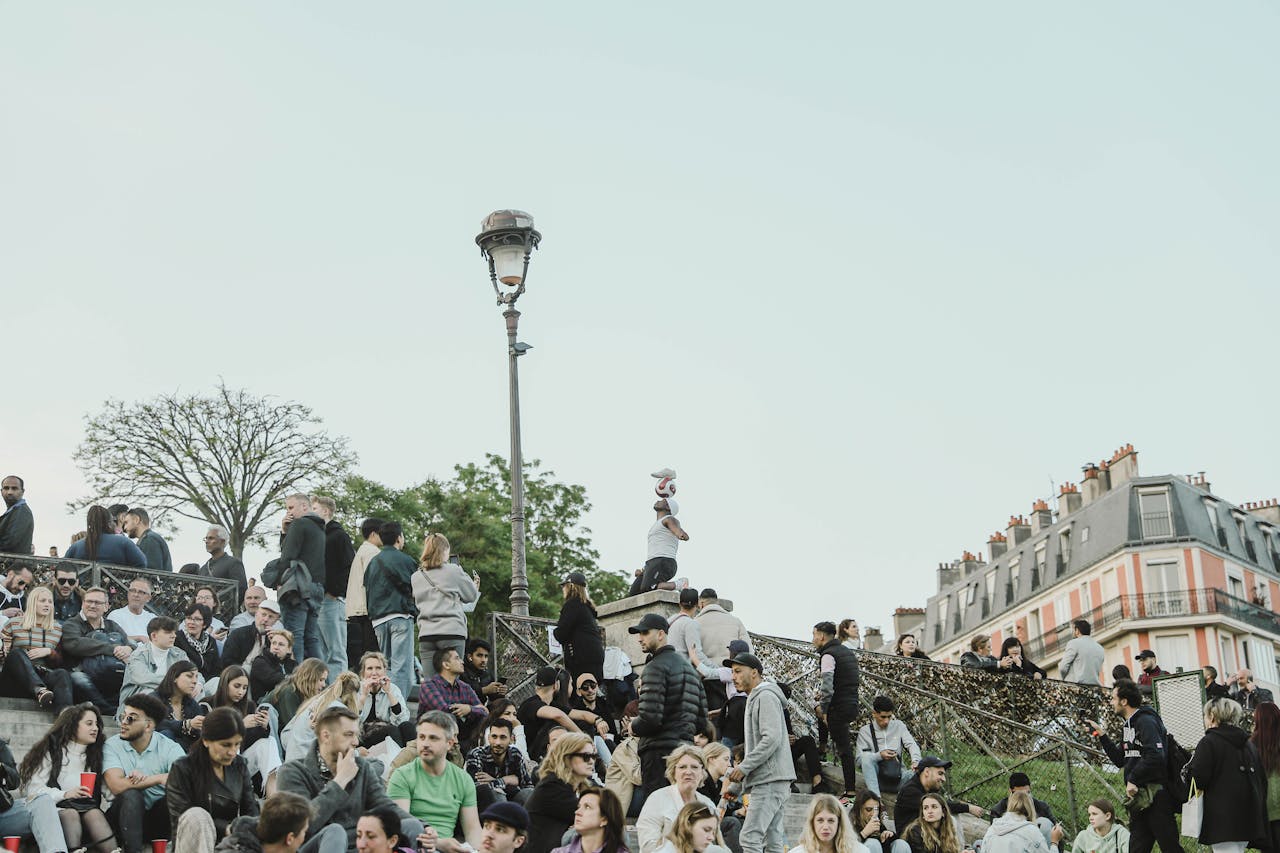
- “It doesn’t look like it’s sinking.”
You probably leveled to the skyline rather than the grass. Rotate until the lawn is ruler-straight. - “The building is distorted.”
Step back and use a longer focal length (or your phone’s 2×). Ultra-wide lenses can exaggerate leaning edges. - “Too many people in frame.”
Compose tighter to crop the lower steps, or wait for a natural gap. Shooting slightly higher, with more lawn than stairs, can simplify the background. - “The sky is blown out.”
Tap to expose for the façade or use HDR on your phone. Overcast days often look better than stark midday sun.
Why add it to your Paris plan?
Because it’s quick, fun, and right next to one of the city’s great free viewpoints. You’re not committing an hour; you’re adding a five-minute pause that delivers a photo your friends will ask about. And since Montmartre rewards wandering, starting (or ending) with the Sinking House lets you fold cafés, street music, and side-street discoveries into the same small loop.
For the rest of the hill, see our Montmartre guide.
Make it easy with the Paris For You app
The Sinking House is pinned inside our Paris Top Insta Spots themed map. Open the Paris For You app, follow turn-by-turn guidance to the exact step where the illusion reads cleanly, and jump to nearby photo stops without switching tools. The app works offline and supports 26 languages, with concise tips, mini audio notes, and quizzes to keep exploring light and fun.
- Explore the app: https://parisforyou.app/
- See our themed maps, including Paris Top Insta Spots, Paris for Free, and more
FAQ
The building is real and perfectly straight. The “sinking” effect is an optical illusion: when you level your camera to the sloping lawn in front of it, the house looks as if it is tilting into the ground.
It is seen from the lawns and staircases right below Sacré-Cœur in Montmartre, the terraced park that climbs from the carousel up to the basilica. On maps it is called Square Louise-Michel. Walk up the main stairs and look to the right near the upper terraces.
Yes. The view is from a public park, so there is no ticket. The park has opening hours and closes in the evening.
Anvers on line 2 is closest to the bottom of the park. Abbesses on line 12 is a good option if you want to combine it with a walk through Montmartre.
Early morning, when the park is quiet, or late afternoon for warmer light. In winter the park closes early, so plan the late-afternoon shot well before closing time.
Useful links
- Paris For You – official site
- Sacré-Cœur information
- Public transport planner (Île-de-France Mobilités)
- Montmartre Funicular
Download the Paris For You app
Explore Paris with offline maps, curated routes, and Insta-ready pins like the Sinking House—all in 26 languages.